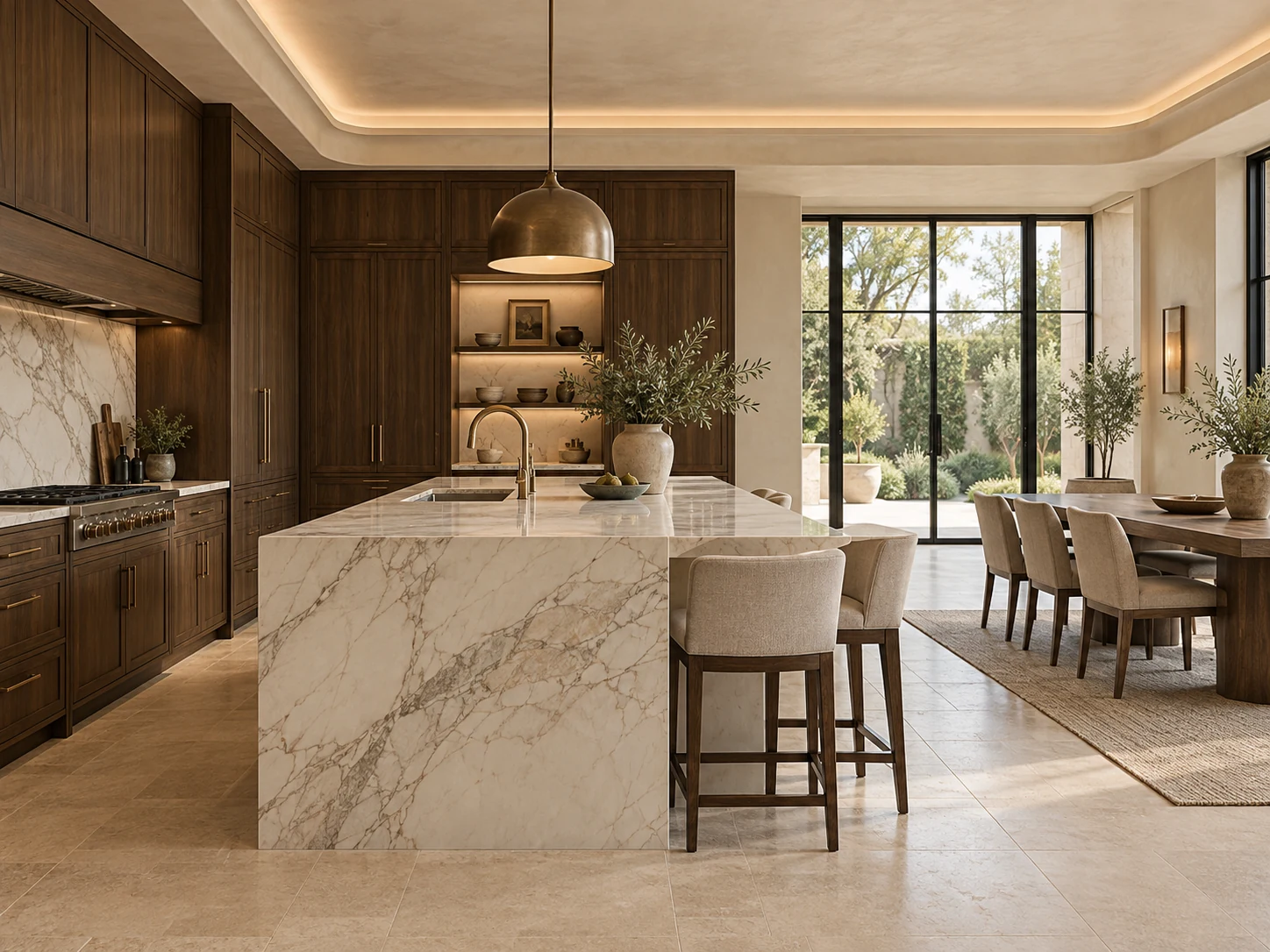
Set a clear material palette
Marble introduces movement and mineral character; timber adds warmth and a sense of craft. Their combination works best when the undertones agree. A warm ivory stone can sit comfortably with walnut, while a cooler stone may need warmer lighting or textiles to balance it.
Start with the surface that is hardest to change. In a kitchen, this may be the selected slab or the cabinetry finish. Build the remaining materials around it and view them under both daylight and the planned evening lighting.
Give the pattern room to breathe
Strongly veined stone draws attention. If every adjacent finish is equally active, the room can feel busy. Quiet cabinet fronts, a restrained timber grain or a simple floor can give the stone the visual space it needs.
Consider where the veining will sit. An island front, a splashback and a fireplace can each become a focal point. Discuss slab layouts, seam positions and the direction of the pattern before cutting starts.
Specify for the way you live
Material selection should reflect everyday use. Marble is sensitive to acidic spills and can develop etching. Sealing may help reduce staining, but it does not prevent acid etching. Some clients appreciate a changing patina; others prefer a surface with different maintenance needs.
Discuss cleaning, cooking habits, moisture exposure and the finish you prefer with the stone fabricator. Ask for care guidance for the selected stone and sealer. Timber finishes should also be matched to the room, particularly around sinks and other wet areas.
Resolve the small junctions
The quality of the composition often becomes clear at the edges: where stone meets cabinetry, where a panel turns a corner and where a handle sits against the grain. These details deserve attention before fabrication.
Coordinate the joinery and stone drawings. Confirm finished dimensions, support requirements, overhangs, edge profiles and the order of installation with the relevant trades. A resolved junction lets the materials feel intentional rather than simply placed beside each other.